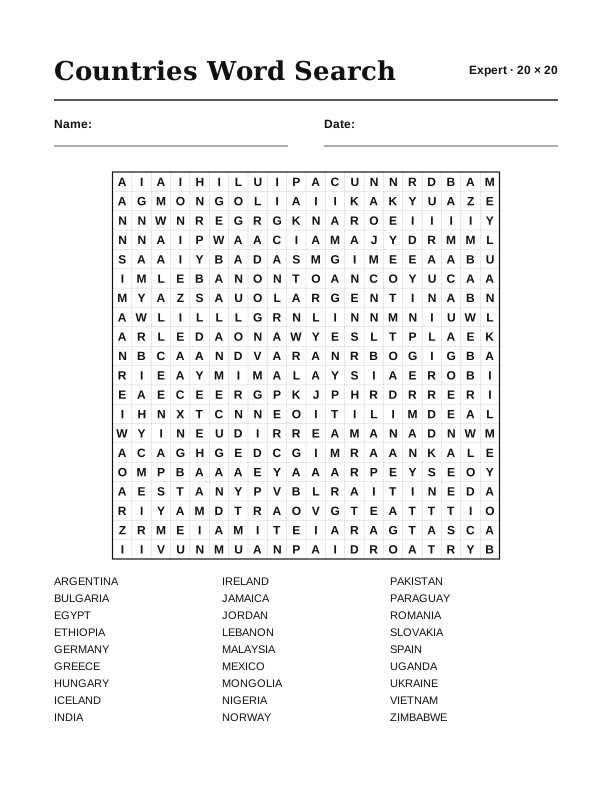
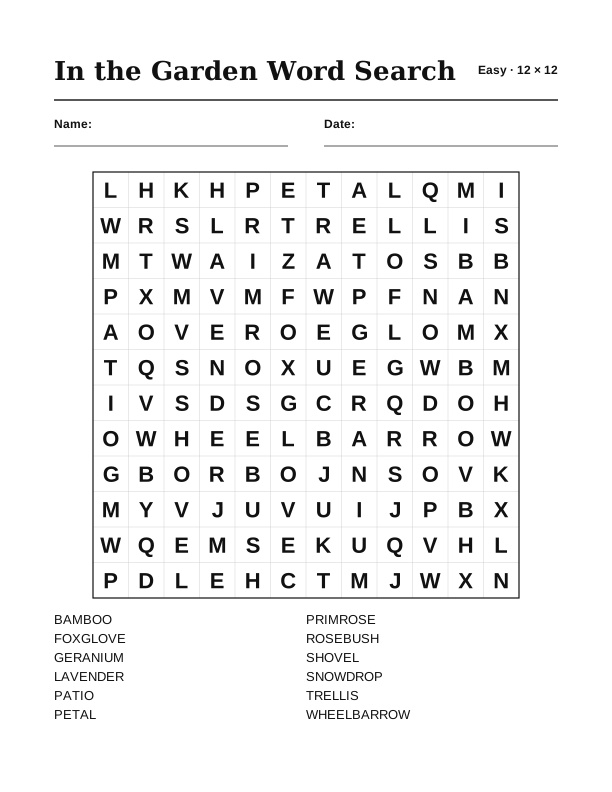
Word search guide
How to play and solve word searches
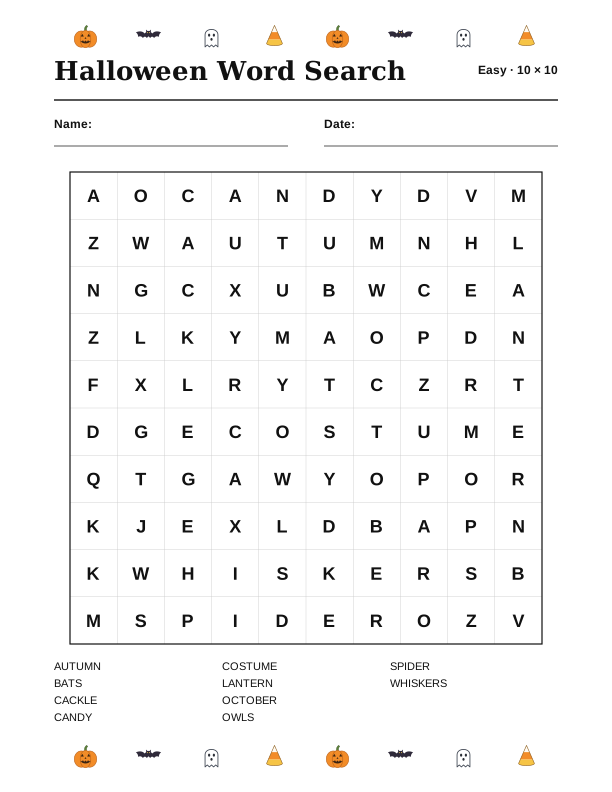
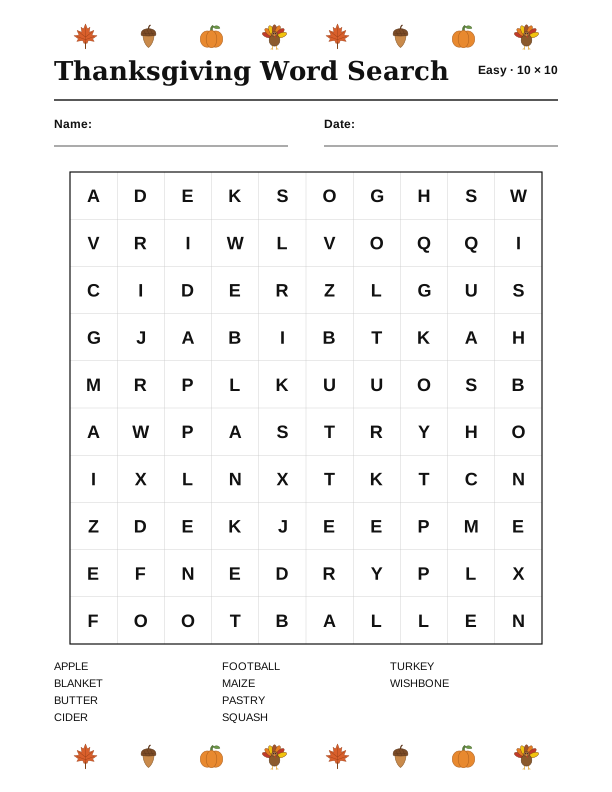
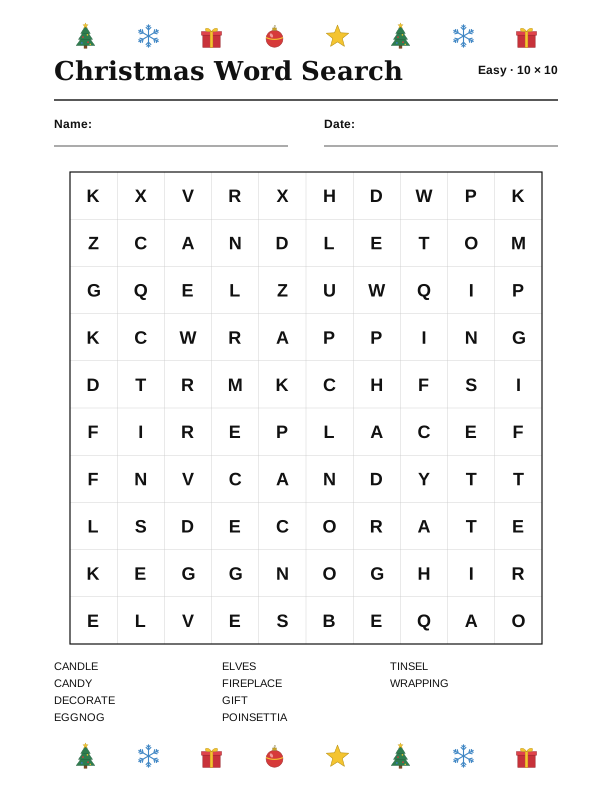
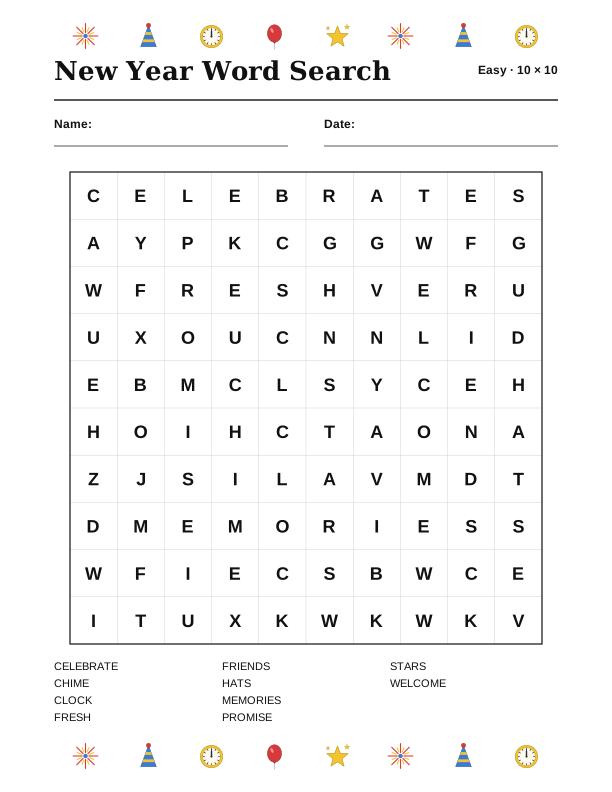
The rules, a method for finding words that you can see working on a real grid from this page, what changes between the levels, and which sheet to print for whom.
How to play a word search
- Every word in the list is hidden in the grid, in a straight line.
- Words can run across, down or on a diagonal; on harder sheets, backward too.
- Find each word, ring it in the grid, and cross it off the list.
- Words can cross and share a letter. The letters left over are just filler.
- The answer key on the next page shows every word ringed.
A word search is also called a word find, word seek or word hunt; they are the same puzzle.
How to find words in a word search, step by step
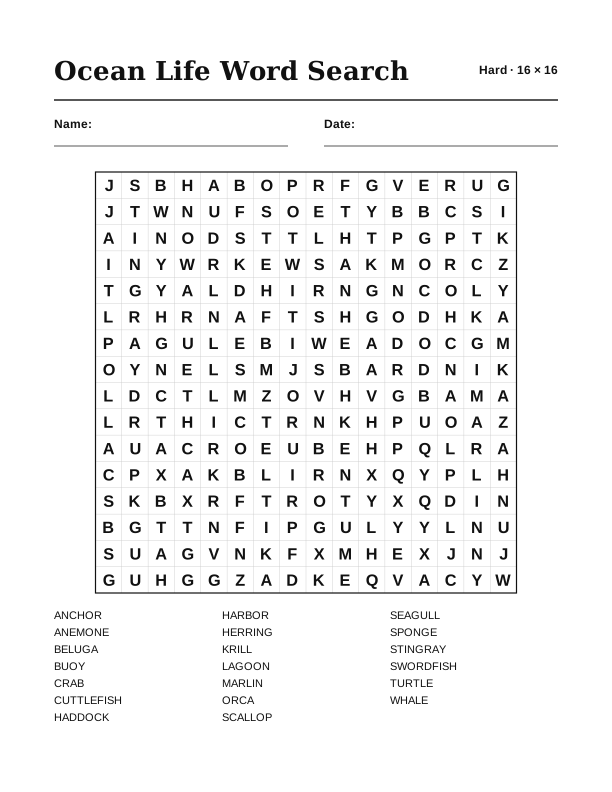
Most people look for a word's first letter. Look for its rarest letter instead. Here is a Hard grid from this page, where words run in all eight directions, and the word RUDDER.
Step 1. R starts the word, but there are 14 of them in this grid. U is the rarest letter in RUDDER: only 6. Shade them.
Step 2. In the word, D sits next to U. Check the eight squares around each U: only one has a D beside it.
Step 3. Follow the line from there in both directions. RUDDER runs on a diagonal. Ring it and cross it off.
When you are stuck
- Hunt the odd letters first. A J, K, Q, X, Y or Z, or a double letter like OO or LL, has few hiding places.
- Go row by row with a finger or a ruler, so your eye does not jump.
- Check backward. On Hard and Expert, a word you cannot find may be running right to left or upward.
- Save the short words for last. By then most squares are already ringed.
Word search difficulty levels: what changes
On most sites the levels are not defined at all, or harder just means a bigger grid with more words, which mostly makes it take longer. Here size is its own setting, and the level decides which way words may run, which is what makes a word hard to spot. Measured on 14 builder grids at each level:
| Level | Where words run | Words on a diagonal | Words running backward |
|---|---|---|---|
| Easy | Across and down only, always forwards | 0% | 0% |
| Medium | Across, down, and forward diagonals | 29% | 0% |
| Hard | All eight directions, including backwards | 34% | 49% |
| Expert | All eight directions with word-letter filler | 33% | 51% |
Expert keeps Hard's eight directions and changes the filler: the leftover squares use letters taken from the word list, so there is no Q-X-Z noise for your eye to skip, and you have to read every square.
Grid size sets how long a sheet takes. The builder suggests a word count for each size, about one word for every 10 to 20 squares, and you can change it:
| Grid | 10×10 | 12×12 | 14×14 | 16×16 | 18×18 | 20×20 | 25×25 | 30×30 |
|---|---|---|---|---|---|---|---|---|
| Words | 10 | 13 | 17 | 20 | 24 | 27 | 36 | 44 |
Answer keys you can trust
- Every word appears exactly once. Each grid is scanned in all eight directions after it is filled; a stray second copy made by filler letters is broken up. All 56 grids measured above came out clean.
- No word hides inside another. BOOK and NOTEBOOK never share a sheet, because finding one would find the other in a square the key does not ring.
- No rude words in the filler. Random letters read eight ways can spell things no one wants on a child's sheet. Each grid is checked against a list of slurs and rude words and the filler is changed until none remain.
- The key says where each word starts. Letters run across the top of the key's grid and numbers down its side, and every word in the key's list carries its first square and an arrow for the way it reads: ANEMONE D5 ↘ on the Hard sheet above. A key printed in gray, where the colors run together, still settles an argument.
Which word search to print
| Who it is for | Settings | Why |
|---|---|---|
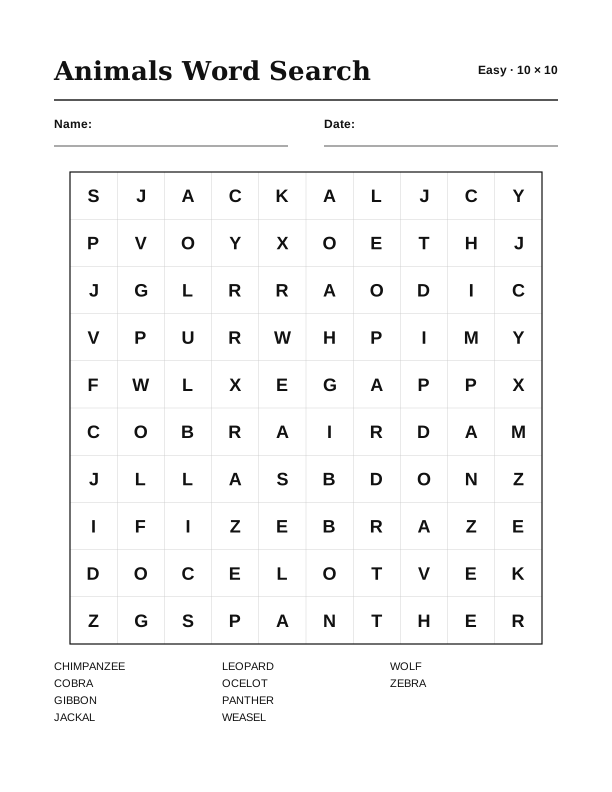
| Early readers, ages 5 to 7 | 10×10, Easy, 10 words, large print | Across and down only, so a child scans one direction at a time without losing their place. |
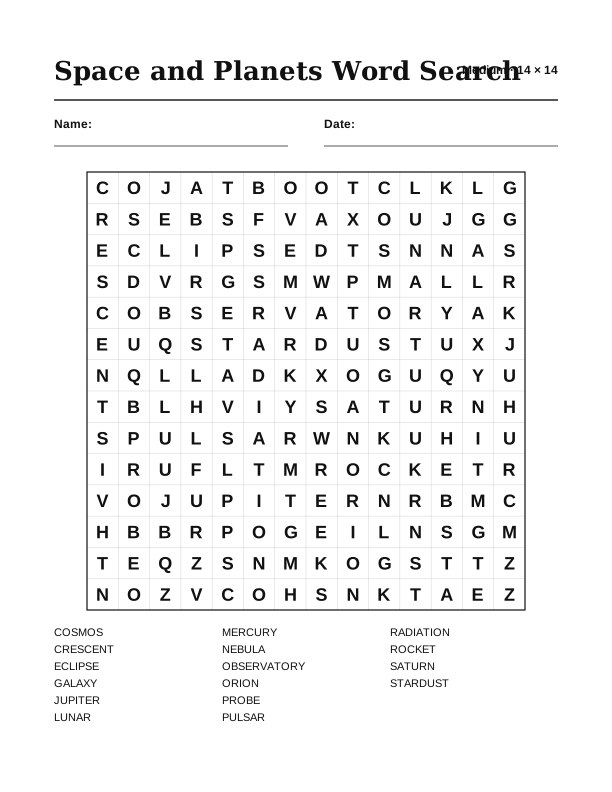
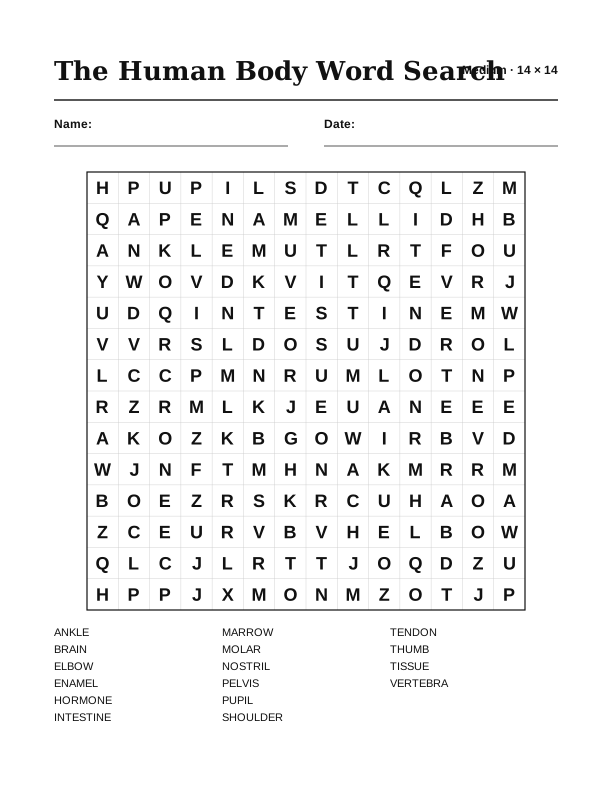
| Elementary classroom | 14×14, Medium, 16 words, name and date on | Diagonals add a challenge while every word still reads left to right or top to bottom. |
| Spelling or vocabulary | Your own list, 12×12, Medium, name and date on | Students meet the exact words they are learning that week. |
| Teenagers and adults | 16×16 or 18×18, Hard, 20 to 24 words | Backward words force a slower, more careful scan. |
| Experienced solvers | 20×20 to 30×30, Expert, 27 to 44 words | Filler taken from the word list removes the shortcuts random letters leave, and a 30×30 is a long sitting. |
| Seniors and low vision | 10×10 or 12×12, Easy, 10 to 12 words, large print | Fewer, bigger letters keep the sheet readable and finishable in one sitting. |
- Mixed reading levels: print the same list at two levels. Everyone works on the same words and nobody can tell who has the easier sheet.
- Your own words: type one per line or separate them with commas. Spaces, hyphens and accents are ignored when hiding the word, and the list prints it as you typed it. Words under three letters, or longer than the grid is wide, are skipped and named.
- Theme lists hold 45 to 65 words each, and every sheet draws a fresh selection, so a pack of six does not repeat itself.
- Hidden message: turn it on in the builder and every square that is not part of a word holds a letter of a message, read across from the top row once all the words are found. Each list starts with a fact, such as "A group of owls is called a parliament" for animals, or type your own. The message decides how many words fit, and it needs a grid of 20×20 or smaller.
- One puzzle per page. A grid and its word list need the room. Answer keys come after the puzzles, so they are easy to hold back.
Free to print, and what this page does not do
Every sheet is made in your browser, so a list with children's names on it never leaves your computer. More in how we make puzzle packs. The terms of use let teachers, libraries, senior centers and families print and copy the sheets and keys.
- A 25×25 or 30×30 grid prints its letters smaller to fit the page with its word list, and large print cannot make them bigger.
- There is no picture word list for children who cannot read yet.
- Picture borders are on the holiday pages only.