December
How to play and solve Christmas word searches
A Christmas word search gets handed out in very different rooms: a second-grade classroom, an office party, a nursing home lounge, and a kitchen table on December 23 when everything else has run out.
How to play a Christmas word search
- Every word in the list is hidden in the grid, in a straight line.
- On Easy, words run across and down only; harder sheets add diagonals, then backward words.
- Find each word, ring it in the grid, and cross it off the list.
- The answer key on the second page shows every word ringed.
How to find Christmas words faster, step by step
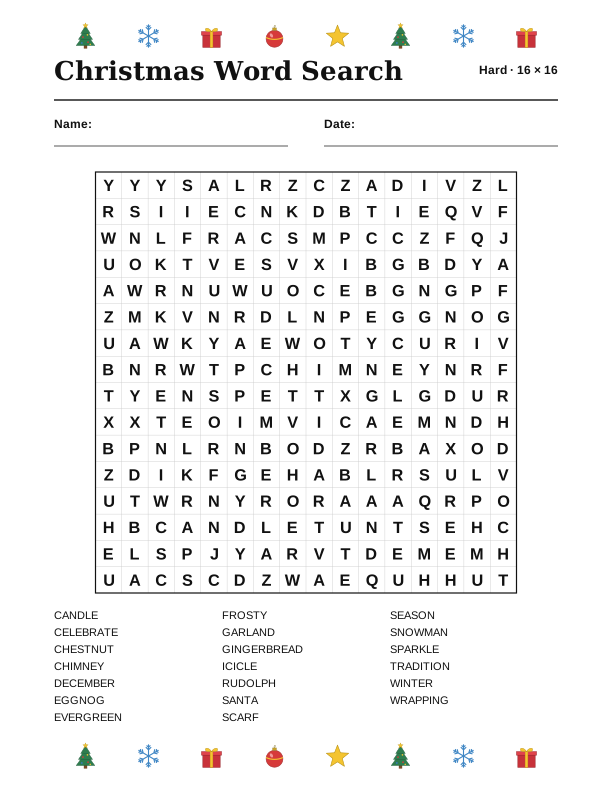
Most people look for a word's first letter. Look for its rarest letter instead. Here is a Hard Christmas grid from this page, where words run in all eight directions, and the word SNOWFLAKE.
Step 1. S starts the word, but there are 16 of them in this grid. L is the rarest letter in SNOWFLAKE: only 5. Shade them.
Step 2. In the word, A sits next to L. Check the eight squares around each L: 2 have an A beside it.
Step 3. Follow the line from there in both directions. SNOWFLAKE runs bottom to top, backward. Ring it and cross it off.
When you are stuck
- Start with the odd letters. On this list, BLIZZARD, COOKIES, JINGLE, JOLLY, JOYFUL and SNOWFLAKE each have a J, K, Q, X or Z, and those letters have few hiding places.
- Go row by row with a finger or a ruler, so your eye does not jump.
- Check backward. On Hard and Expert, a word you cannot find may be running right to left or upward.
- Save the short words for last. By then most squares are already ringed.
Which Christmas words are religious, and a list for public school classrooms
The list is built to work in all of them, which mostly means keeping it concrete: almost every word is a thing you could point at. The one real decision is about the handful of words that are religious, and the right answer depends entirely on the room.
Most Christmas vocabulary is secular. SANTA, REINDEER, STOCKING, SNOWMAN and GINGERBREAD belong to the holiday as a season, and almost any classroom can use them. A handful of words belong to the religious story instead: NATIVITY, MANGER, ANGEL and NOEL.
That handful matters in a US public school, where many districts ask teachers to keep classroom materials free of religious content. It matters the other way in a church group, a Christian school or a family that wants the story on the sheet. So the page offers both: the default list leaves those four words out, and the full list puts them back in one click.
Neither list is the right one. They suit different rooms, and the only real mistake is finding out which one you printed after it has been handed out. For a class that avoids holiday content altogether, paste a list of winter words into the custom list instead.
The classroom list: 60 words
Every word except the four religious ones: NATIVITY, MANGER, ANGEL and NOEL. This is the default on this page.
- Elves
- Bells
- Blizzard
- Candle
- Carol
- Celebrate
- Chestnut
- Chimney
- Christmas
- Cocoa
- Cookies
- Cranberry
- December
- Decorate
- Evergreen
- Peppermint
- Family
- Feast
- Festive
- Fireplace
- Frosty
- Garland
- Gingerbread
- Glitter
- Snowman
- Holiday
- Holly
- Icicle
- Jingle
- Jolly
- Joyful
- Lantern
- Merry
- Mistletoe
- Mittens
- Ornament
- Poinsettia
- Wrapping
- Present
- Eggnog
- Reindeer
- Ribbon
- Rudolph
- Santa
- Scarf
- Season
- Sleigh
- Snowflake
- Sparkle
- Stocking
- Tinsel
- Toys
- Tradition
- Turkey
- Winter
- Wreath
- Yuletide
- Tree
- Gift
- Candy
The other 4, and why they are separate
These are on the full list rather than the default one. They are not harder to find; they are a different decision about the room you are printing for.
- Angel
- Manger
- Nativity
- Noel
Both lists are checked when this site is built: every word is four to twelve letters, no word contains another word on the same list, and the default list is a true part of the full one. A word inside another word has no honest answer key, so that check fails the build rather than being repaired quietly at print time.
Which Christmas word search to print
| Who it is for | Sheet | Settings | Squares that are part of a word |
|---|---|---|---|
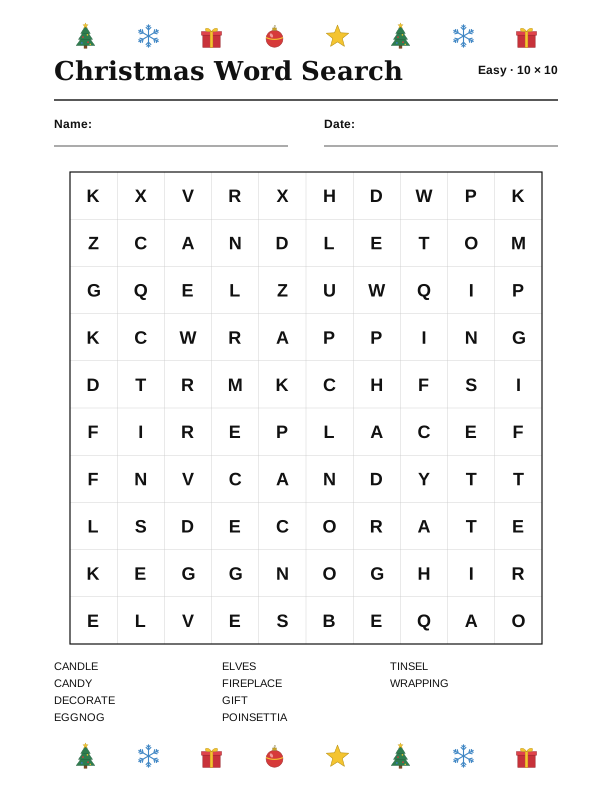
| Ages 5 to 7 | Easy | Easy, 10×10, 10 words, classroom list | 60% |
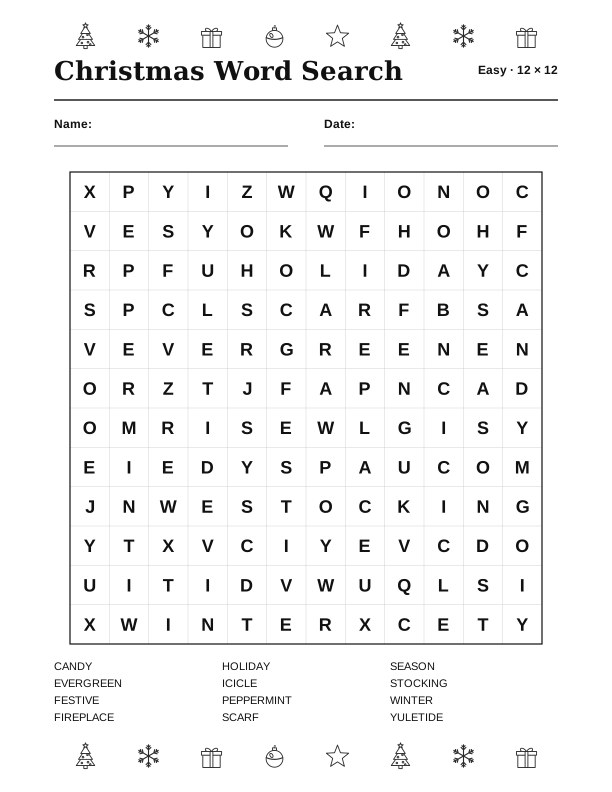
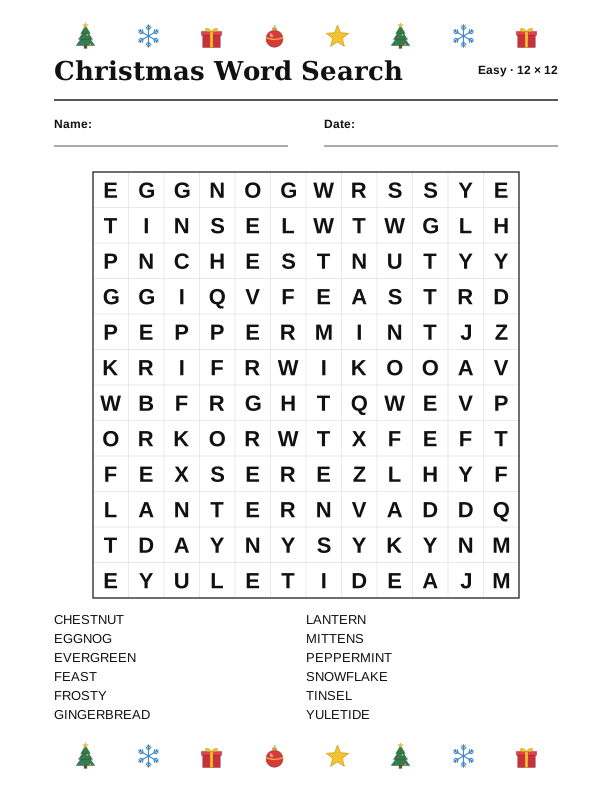
| Young children who finish early | Easy, with pictures to color | Easy, 12×12, 12 words, classroom list, outlines to color | 53% |
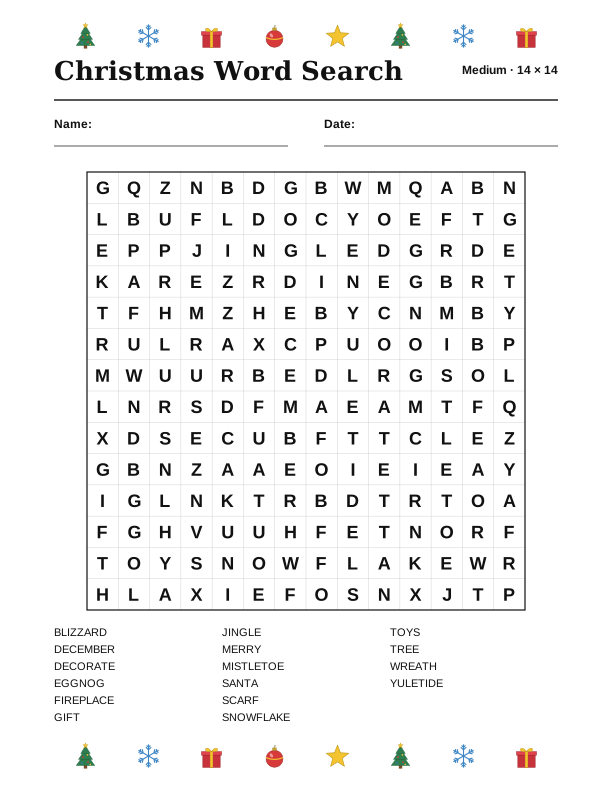
| Grades 2 to 5 | Medium | Medium, 14×14, 16 words, classroom list | 46% |
| Teens and family tables | Hard | Hard, 16×16, 20 words, classroom list | 46% |
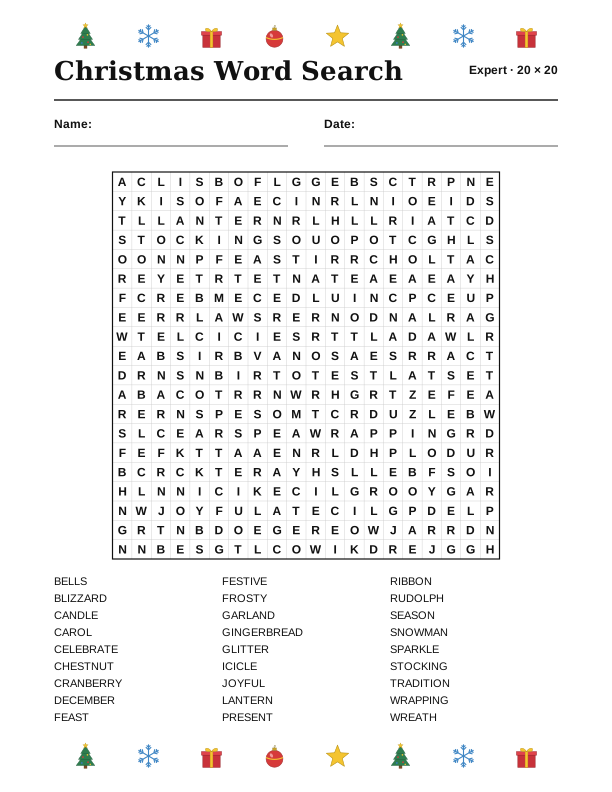
| Adults and puzzle fans | Expert, for adults | Expert, 20×20, 27 words, classroom list | 40% |
| Seniors and low vision | Large print | Easy, 12×12, 12 words, classroom list, large print | 55% |
Measured on the six sheets above, which the cards download.
- The level decides which way words run, and that is what makes a word hard to spot: Easy is across and down only, which a young child can scan one direction at a time.
- Grid size is not difficulty. A bigger grid is a longer hunt through more filler: 60% of the 10×10 sheet is part of a word, against 40% of the 20×20 one.
- Expert fills the empty squares with letters taken from the word list itself, so hunting for an unusual letter stops working.
- Large print with a smaller grid beats normal print with a bigger one for anyone working with a magnifier.
- Hidden message: turn it on in the builder and every square that is not part of a word holds a letter of "Wishing you a merry Christmas and a happy New Year", read across from the top row once all the words are found. Type your own instead for a class or a party; the message decides how many words fit.
Answer keys you can trust
- Every word appears exactly once. Each grid is scanned in all eight directions after it is filled, and a stray second copy made by the filler letters is broken up. The six sheets above were checked this way when this page was built.
- No word hides inside another. Two words where one contains the other never share a list, because finding one would find the other in squares the key does not ring.
- No rude words in the filler. Random letters read eight ways can spell things no one wants on a child's sheet. Every grid is checked in every direction and its filler changed until none remain.
- The key is page 2 of the same PDF, drawn from the same grid, so it cannot belong to a different puzzle.
- The key says where each word starts. Letters run across the top of its grid and numbers down the side, and each word in its list carries its first square and an arrow: EVERGREEN J16 ↖ on the Hard sheet above. A key printed in gray still settles an argument.
Christmas word search activities
The pictures, and when to switch them off
The Christmas pictures along the top and bottom of the puzzle page are simple drawings made for this site. They sit in the page margins, so they never shrink the grid or the word list, and they stay off the answer key.
- In color is the default, and it is the one to use for a party table or a fridge door.
- Outlines to color in turns the border into something to color, which gives the child who finishes first something to do with the crayons. It also uses almost no ink.
- No pictures suits older students and adults, and anyone photocopying a class set who wants the cleanest copy.
Free to print, and what this page does not do
Every sheet is made in your browser and there is no account, so a pasted word list never leaves your computer. More in how we make puzzle packs. The terms of use let teachers, parents, clubs, libraries and senior centers print and copy the sheets and their answer keys.
- A hidden message needs a grid of 20×20 or smaller. The whole Christmas list covers at most 433 squares, so on a 30×30 the message would need 467 letters or more.
- Your own word list keeps the pictures, but its words are not checked against the holiday list.