Kakuro guide
How to play and solve Kakuro
The rules fit in four lines. Solving is addition and a little logic, and below it is shown on a real puzzle from this page, one step at a time, with the reason for every digit.
How to play Kakuro
- Fill every white square with a digit from 1 to 9.
- A run is a line of white squares across or down, between dark squares.
- The digits in a run add up to its clue: the number above the diagonal is for the run to its right, the number below it for the run underneath.
- A digit never repeats inside a run. It can appear again elsewhere in the same row, once a dark square has ended the run.
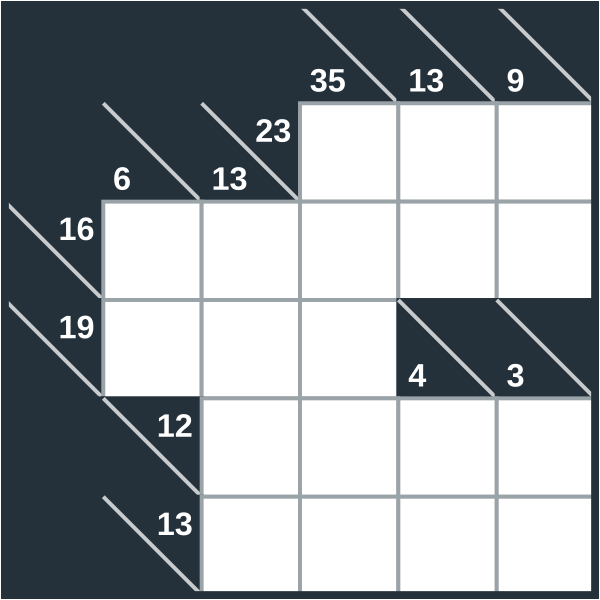
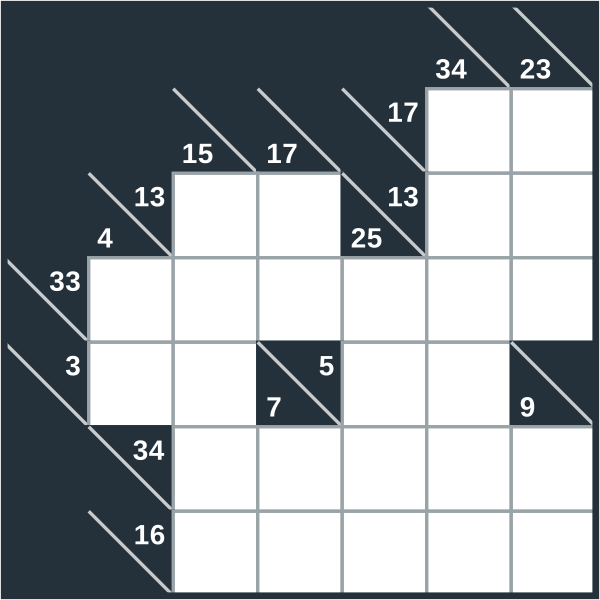
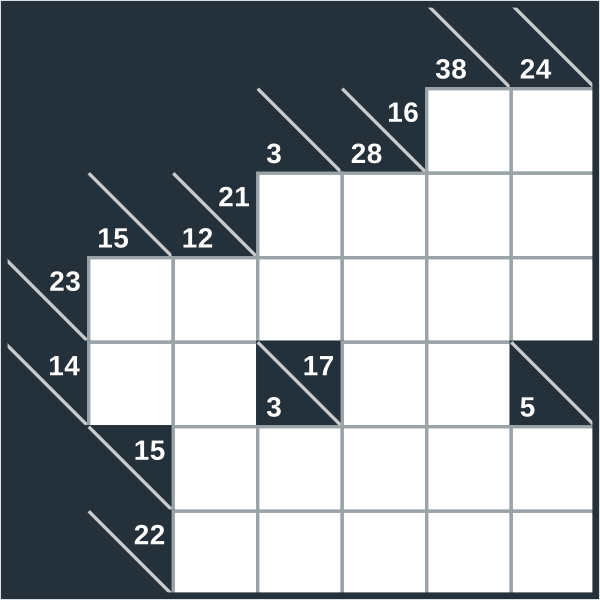
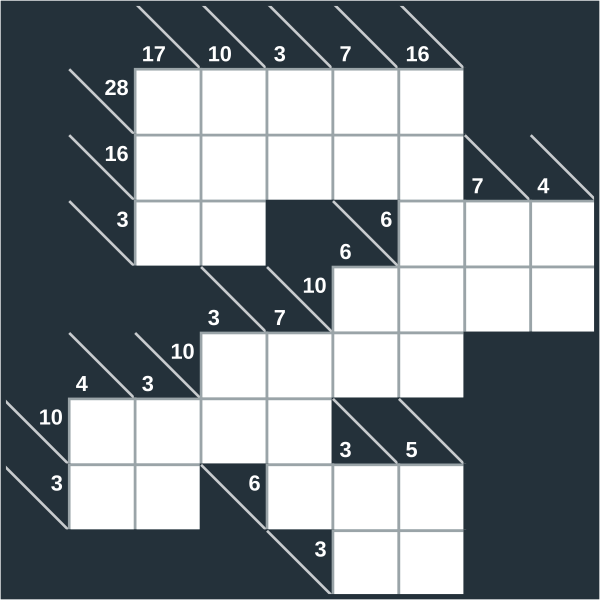
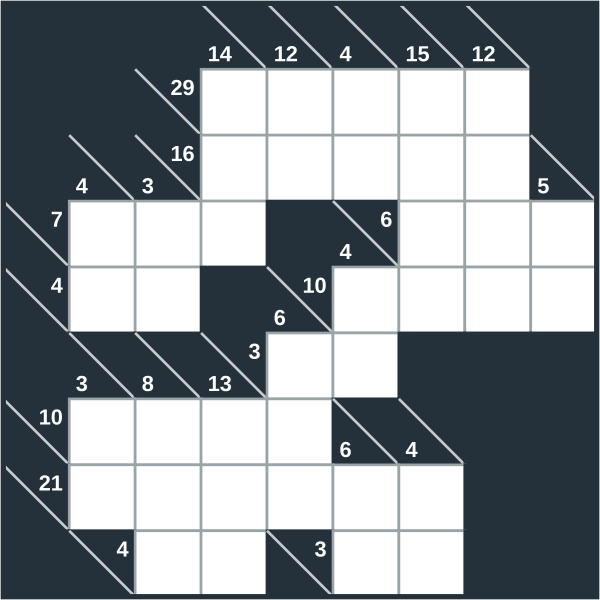
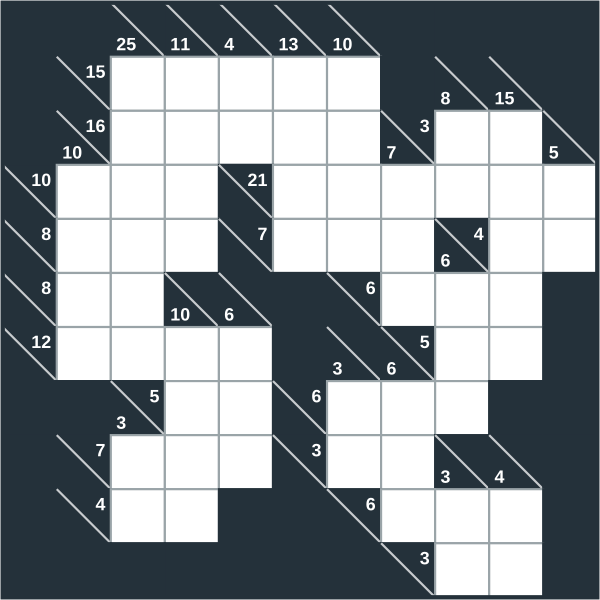
Kakuro began in American puzzle magazines as Cross Sums, and some books still call it Cross Addition; the Japanese name is short for "addition cross." It works like a crossword with numbers, and every square belongs to one run across and one run down, which is what makes it a logic puzzle rather than a sum. Here is a 6×6 from this page, and its answer.
How to solve a Kakuro, step by step
This is an Easy 6×6 from this page's bank, solved with three moves you can make on paper. Each step is computed from the puzzle, not written by hand, so the reasons are exactly what the grid allows. The highlighted square is the one each step fills, and the shaded squares are the runs it reads.
Step 1. Row 3, column 5: the across run in row 3 (4 squares totaling 11) can only be 1 + 2 + 3 + 5, and the down run in column 5 (5 squares totaling 35) can only be 5 + 6 + 7 + 8 + 9. The only digit both allow is 5.
Step 2. Row 4, column 3: the across run in row 4 (4 squares totaling 29) can only be 5 + 7 + 8 + 9, and the down run in column 3 (4 squares totaling 11) can only be 1 + 2 + 3 + 5. The only digit both allow is 5.
Step 3. Row 5, column 5: the across run in row 5 (5 squares totaling 16) can only be 1 + 2 + 3 + 4 + 6, and the down run in column 5 totals 35 and already has 5, so its other 4 squares make 30 and can only be 6 + 7 + 8 + 9. The only digit both allow is 6.
Step 4. Row 6, column 5: the across run in row 6 (2 squares totaling 8) can only be 1 + 7, 2 + 6 or 3 + 5, and the down run in column 5 totals 35 and already has 5 and 6, so its other 3 squares make 24 and can only be 7 + 8 + 9. The only digit both allow is 7.
Step 5. The across run in row 6 totals 8 and already has 7, so its last square, row 6, column 6, is 8 − 7 = 1.
Step 6. The down run in column 6 totals 4 and already has 1, so its last square, row 5, column 6, is 4 − 1 = 3.
Step 7. The down run in column 3 totals 11 and already has 5, so its other 3 squares must be 1, 2 and 3. The 3 can only go at row 3, column 3: the runs crossing its other empty squares cannot take a 3.
Step 8. Row 3, column 6: the across run in row 3 totals 11 and already has 3 and 5, so its other 2 squares make 3 and can only be 1 + 2, and the down run in column 6 (2 squares totaling 11) can only be 2 + 9, 3 + 8, 4 + 7 or 5 + 6. The only digit both allow is 2.
Step 1 is the classic way into a Kakuro: two runs crossing where each total can only be made one way, so only a digit in both sets fits the square. Step 7 is the other way round: a digit the run has to use, with only one square left that its crossing run allows.
The other 12 steps use the same moves: last square in a run (9) and the only digit both runs allow (3). Try them on the grid before you open the list.
Show steps 9 to 20
- The down run in column 6 totals 11 and already has 2, so its last square, row 2, column 6, is 11 − 2 = 9.
- The across run in row 3 totals 11 and already has 3, 5 and 2, so its last square, row 3, column 4, is 11 − 10 = 1.
- Row 2, column 5: the across run in row 2 totals 24 and already has 9, so its other 2 squares make 15 and can only be 7 + 8, and the down run in column 5 totals 35 and already has 5, 6 and 7, so its other 2 squares make 17 and can only be 8 + 9. The only digit both allow is 8.
- The down run in column 5 totals 35 and already has 8, 5, 6 and 7, so its last square, row 4, column 5, is 35 − 26 = 9.
- The across run in row 2 totals 24 and already has 8 and 9, so its last square, row 2, column 4, is 24 − 17 = 7.
- Row 4, column 4: the across run in row 4 totals 29 and already has 5 and 9, so its other 2 squares make 15 and can only be 7 + 8, and the down run in column 4 totals 18 and already has 7 and 1, so its other 2 squares make 10 and can only be 2 + 8 or 4 + 6. The only digit both allow is 8.
- The down run in column 4 totals 18 and already has 7, 1 and 8, so its last square, row 5, column 4, is 18 − 16 = 2.
- The across run in row 4 totals 29 and already has 5, 8 and 9, so its last square, row 4, column 2, is 29 − 22 = 7.
- Row 5, column 3: the across run in row 5 totals 16 and already has 2, 6 and 3, so its other 2 squares make 5 and can only be 1 + 4, and the down run in column 3 totals 11 and already has 3 and 5, so its other 2 squares make 3 and can only be 1 + 2. The only digit both allow is 1.
- The down run in column 3 totals 11 and already has 3, 5 and 1, so its last square, row 6, column 3, is 11 − 9 = 2.
- The across run in row 5 totals 16 and already has 1, 2, 6 and 3, so its last square, row 5, column 2, is 16 − 12 = 4.
- The down run in column 2 totals 12 and already has 7 and 4, so its last square, row 6, column 2, is 12 − 11 = 1.
Three mistakes that cost the most time
- Reading a clue the wrong way. Above the diagonal is the run to the right; below it is the run going down.
- Treating a row like a Sudoku row. The no-repeat rule is for one run. After a dark square, a new run can use the same digits again.
- Fixing the order too early. A two-square 3 is 1 and 2, but which square takes the 1 is decided by the run crossing it.
Kakuro combinations
The fastest start on any sheet is a run whose total can only be made one way. These are all of them, for every run length from 2 to 9 squares. Two of them are worth remembering on their own: a run of 9 squares always totals 45, and every total for 8 squares has only one answer, because the digit left out is 45 minus the clue.
| Run length | Totals with only one answer |
|---|---|
| 2 squares | 3 = 1 24 = 1 316 = 7 917 = 8 9 |
| 3 squares | 6 = 1 2 37 = 1 2 423 = 6 8 924 = 7 8 9 |
| 4 squares | 10 = 1 2 3 411 = 1 2 3 529 = 5 7 8 930 = 6 7 8 9 |
| 5 squares | 15 = 1 2 3 4 516 = 1 2 3 4 634 = 4 6 7 8 935 = 5 6 7 8 9 |
| 6 squares | 21 = 1 2 3 4 5 622 = 1 2 3 4 5 738 = 3 5 6 7 8 939 = 4 5 6 7 8 9 |
| 7 squares | 28 = 1 2 3 4 5 6 729 = 1 2 3 4 5 6 841 = 2 4 5 6 7 8 942 = 3 4 5 6 7 8 9 |
| 8 squares | 36 = 1 2 3 4 5 6 7 837 = 1 2 3 4 5 6 7 938 = 1 2 3 4 5 6 8 939 = 1 2 3 4 5 7 8 940 = 1 2 3 4 6 7 8 941 = 1 2 3 5 6 7 8 942 = 1 2 4 5 6 7 8 943 = 1 3 4 5 6 7 8 944 = 2 3 4 5 6 7 8 9 |
| 9 squares | 45 = 1 2 3 4 5 6 7 8 9 |
Worked out from every set of different digits when this page is built: 34 totals in all.
Show every combination for 2, 3 and 4 squares
| Total | Digits |
|---|---|
| 3 | 1 2 |
| 4 | 1 3 |
| 5 | 1 42 3 |
| 6 | 1 52 4 |
| 7 | 1 62 53 4 |
| 8 | 1 72 63 5 |
| 9 | 1 82 73 64 5 |
| 10 | 1 92 83 74 6 |
| 11 | 2 93 84 75 6 |
| 12 | 3 94 85 7 |
| 13 | 4 95 86 7 |
| 14 | 5 96 8 |
| 15 | 6 97 8 |
| 16 | 7 9 |
| 17 | 8 9 |
| Total | Digits |
|---|---|
| 6 | 1 2 3 |
| 7 | 1 2 4 |
| 8 | 1 2 51 3 4 |
| 9 | 1 2 61 3 52 3 4 |
| 10 | 1 2 71 3 61 4 52 3 5 |
| 11 | 1 2 81 3 71 4 62 3 62 4 5 |
| 12 | 1 2 91 3 81 4 71 5 62 3 72 4 63 4 5 |
| 13 | 1 3 91 4 81 5 72 3 82 4 72 5 63 4 6 |
| 14 | 1 4 91 5 81 6 72 3 92 4 82 5 73 4 73 5 6 |
| 15 | 1 5 91 6 82 4 92 5 82 6 73 4 83 5 74 5 6 |
| 16 | 1 6 91 7 82 5 92 6 83 4 93 5 83 6 74 5 7 |
| 17 | 1 7 92 6 92 7 83 5 93 6 84 5 84 6 7 |
| 18 | 1 8 92 7 93 6 93 7 84 5 94 6 85 6 7 |
| 19 | 2 8 93 7 94 6 94 7 85 6 8 |
| 20 | 3 8 94 7 95 6 95 7 8 |
| 21 | 4 8 95 7 96 7 8 |
| 22 | 5 8 96 7 9 |
| 23 | 6 8 9 |
| 24 | 7 8 9 |
| Total | Digits |
|---|---|
| 10 | 1 2 3 4 |
| 11 | 1 2 3 5 |
| 12 | 1 2 3 61 2 4 5 |
| 13 | 1 2 3 71 2 4 61 3 4 5 |
| 14 | 1 2 3 81 2 4 71 2 5 61 3 4 62 3 4 5 |
| 15 | 1 2 3 91 2 4 81 2 5 71 3 4 71 3 5 62 3 4 6 |
| 16 | 1 2 4 91 2 5 81 2 6 71 3 4 81 3 5 71 4 5 62 3 4 72 3 5 6 |
| 17 | 1 2 5 91 2 6 81 3 4 91 3 5 81 3 6 71 4 5 72 3 4 82 3 5 72 4 5 6 |
| 18 | 1 2 6 91 2 7 81 3 5 91 3 6 81 4 5 81 4 6 72 3 4 92 3 5 82 3 6 72 4 5 73 4 5 6 |
| 19 | 1 2 7 91 3 6 91 3 7 81 4 5 91 4 6 81 5 6 72 3 5 92 3 6 82 4 5 82 4 6 73 4 5 7 |
| 20 | 1 2 8 91 3 7 91 4 6 91 4 7 81 5 6 82 3 6 92 3 7 82 4 5 92 4 6 82 5 6 73 4 5 83 4 6 7 |
| 21 | 1 3 8 91 4 7 91 5 6 91 5 7 82 3 7 92 4 6 92 4 7 82 5 6 83 4 5 93 4 6 83 5 6 7 |
| 22 | 1 4 8 91 5 7 91 6 7 82 3 8 92 4 7 92 5 6 92 5 7 83 4 6 93 4 7 83 5 6 84 5 6 7 |
| 23 | 1 5 8 91 6 7 92 4 8 92 5 7 92 6 7 83 4 7 93 5 6 93 5 7 84 5 6 8 |
| 24 | 1 6 8 92 5 8 92 6 7 93 4 8 93 5 7 93 6 7 84 5 6 94 5 7 8 |
| 25 | 1 7 8 92 6 8 93 5 8 93 6 7 94 5 7 94 6 7 8 |
| 26 | 2 7 8 93 6 8 94 5 8 94 6 7 95 6 7 8 |
| 27 | 3 7 8 94 6 8 95 6 7 9 |
| 28 | 4 7 8 95 6 8 9 |
| 29 | 5 7 8 9 |
| 30 | 6 7 8 9 |
Runs of five squares or more
A long run is easier to read from the digits it leaves out. A run of 7 squares totaling 38 leaves out 2 digits that add up to 7: 1 and 6, 2 and 5, or 3 and 4. So the run is 2 3 4 5 7 8 9, or 1 3 4 6 7 8 9, or 1 2 5 6 7 8 9. Look up 9 minus the run's length in the chart, at 45 minus its total, and the run holds everything else.
To print the chart with your puzzles, check Add the combinations chart in the builder. It goes in as one page after the puzzles.
Kakuro difficulty levels, and what each one asks
A level here is what a puzzle needs, not how big it is. Every puzzle in the bank was solved by a program limited to moves a person makes on paper, and its level is the first set of moves that finished it. Grid size is a separate choice: a 10×10 Easy needs no pencil marks, while a 7×7 Hard needs a digit tested.
| Level | What it needs | Puzzles | Sizes |
|---|---|---|---|
| Easy | The three moves above, with no pencil marks. | 342 | 6×6, 7×7, 8×8, 9×9, 10×10, 11×11 |
| Medium | Pencil marks: the digits each run allows, written small in its squares and crossed off as the crossing runs rule them out. | 595 | 6×6, 7×7, 8×8, 9×9, 10×10, 11×11 |
| Hard | Testing a digit: in a square with two possibilities, pencil one in and follow it until a run cannot be made, which proves it wrong. A Hard sheet needs 1.7 tests on average. | 217 | 7×7, 8×8, 9×9, 10×10, 11×11 |
Every one of the 1,154 puzzles is graded again each time this page is built. The few that could not be finished even by testing digits one at a time were taken out, so none of them requires guessing.
There is no Hard 6×6: every puzzle that size can be finished with pencil marks. A few size and level pairs are thin, so a pack there may repeat what you printed last time: 5 Easy 8×8, 9 Hard 8×8, 4 Easy 11×11.
Which Kakuro to print
Grid size decides how long a sheet takes and how big the sums get. The level decides whether you need pencil marks. These are the settings we would start from.
| Who it is for | Settings | Why |
|---|---|---|
| A first Kakuro | 6×6, Easy, one per page, rules page on | No pencil marks needed, and plenty of room to read each clue. |
| Children practicing addition | 6×6, Easy, two per page, name and date on | Runs of at most 5 squares with totals up to 35: mental addition with a reason behind every answer. |
| Learning pencil marks | 7×7, Medium, combinations chart on | Medium is where writing the possible digits small starts to matter, and the chart saves working out each total. |
| Older eyes | 6×6 or 7×7, large print | Large print gives each puzzle a whole page, so the clue numbers print larger. |
| Regular solvers | 9×9 or 10×10, Medium | 152 and 156 puzzles, so a weekly pack rarely repeats. |
| Puzzle fans | 9×9 to 11×11, Hard | Long runs, and at least one square where a digit has to be tested. |
- Answer keys come with every PDF, two to a page, with no sign-up or password.
- Ink-saving clues print the dark squares as outlines, which matters across a class set.
- The grids stop at 11×11. Some sites go up to 15×15; this page does not make those yet.
- The puzzles come from a fixed bank, so the same settings give the same pack. Press New puzzle set for a different one.
Free to print and copy
Every puzzle here has been checked to have exactly one answer, and graded by what it takes to reach it. More on that in how we make puzzle packs. The terms of use let teachers, tutors, clubs and families print and copy the puzzles and the answer keys without asking.