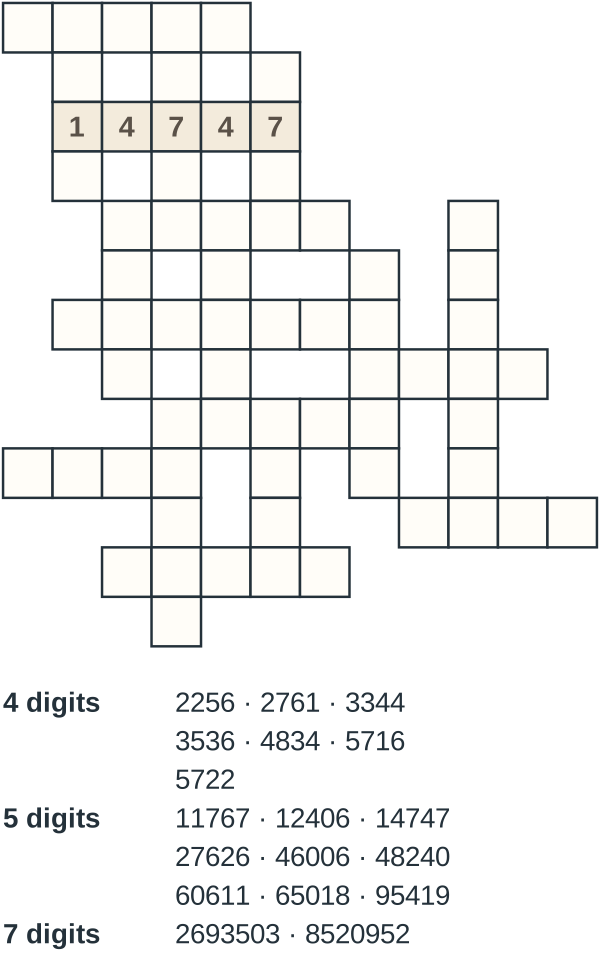
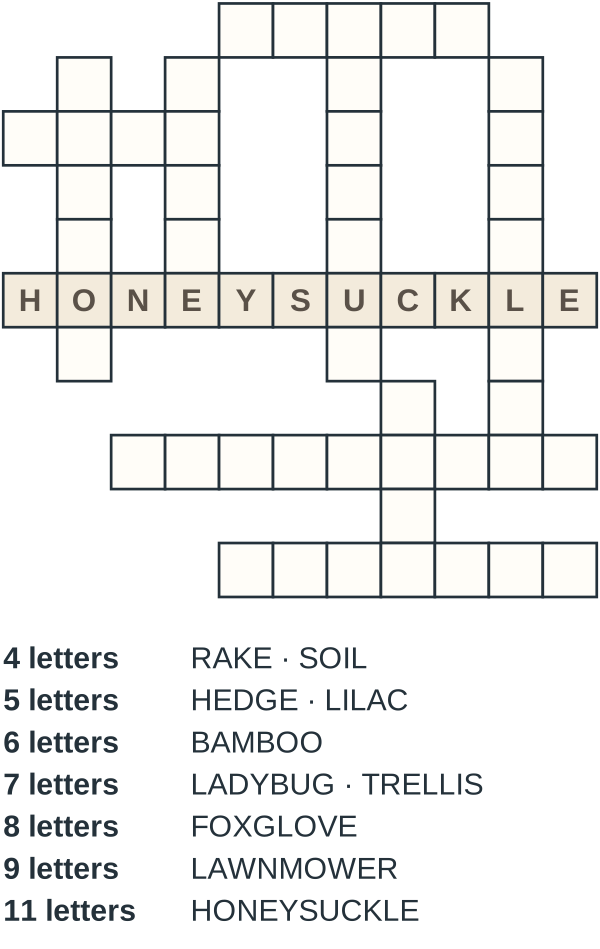
Fill-in guide
How to play and solve fill-in puzzles
There are no clues: the list is the clue, and the shape of the grid tells you where each word goes. Below is how to play, a real puzzle from this page solved word by word, and which sheet to print for whom.
How to play a fill-in puzzle
- Every word on the list goes into the grid exactly once, reading left to right or top to bottom.
- Where an across word and a down word cross, they share the letter in that square.
- The list is grouped by length, and a slot's length tells you which group to look in.
- Cross each word off the list as you place it. When the list is empty, the grid is full.
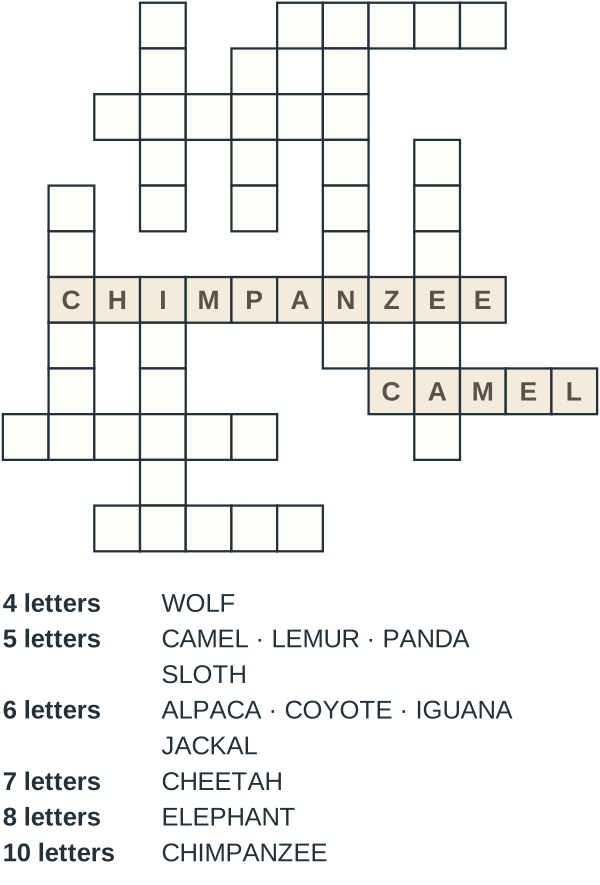
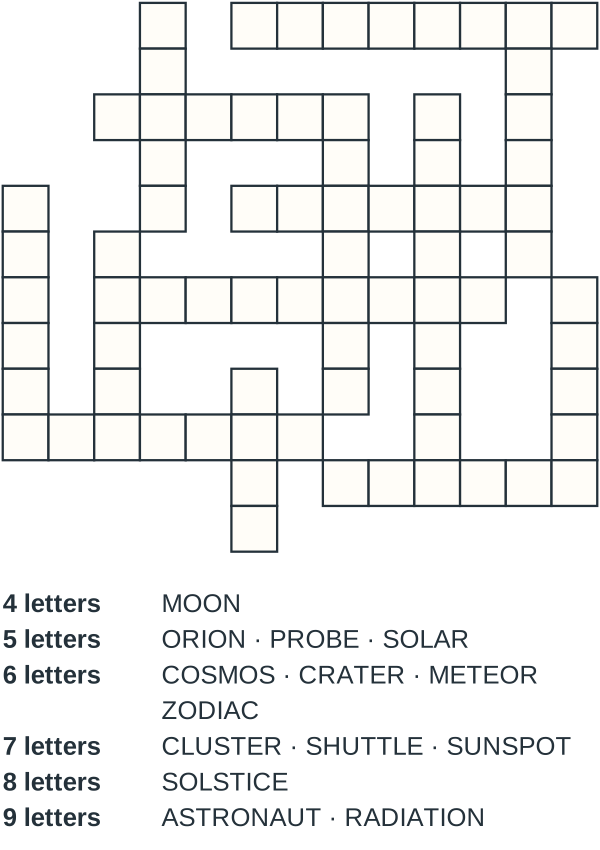
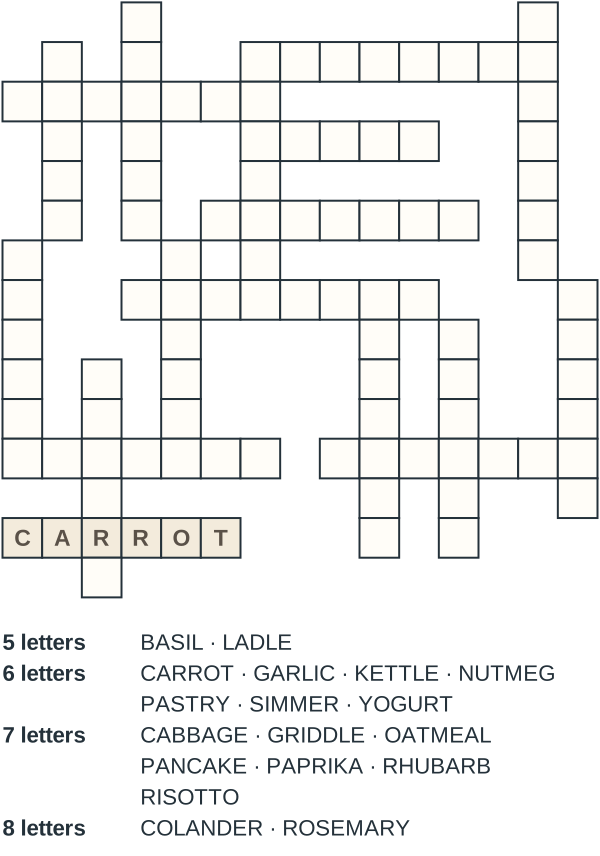
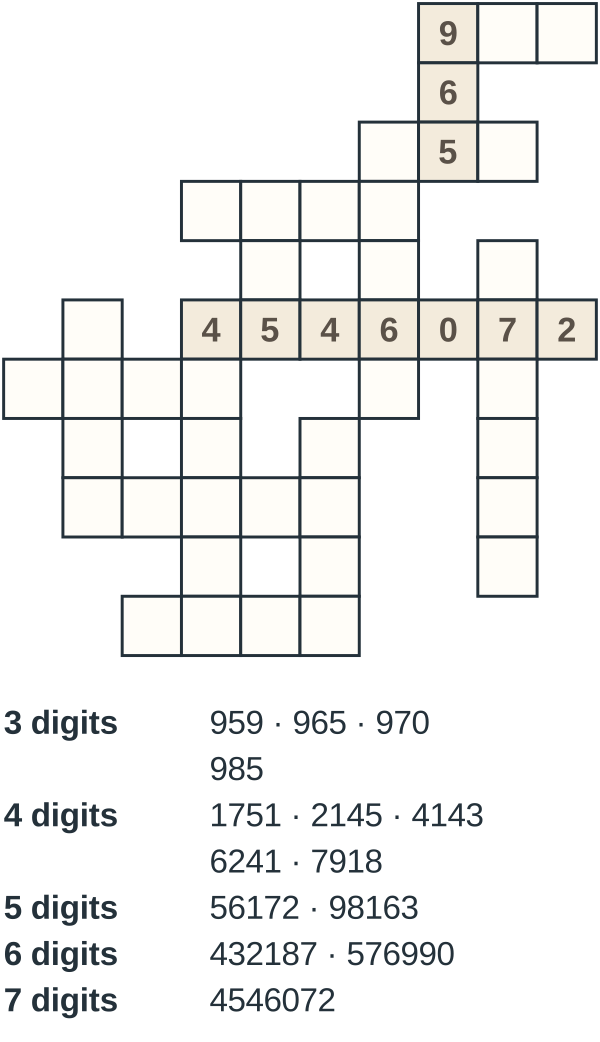
Fill-ins are also sold as Fill-It-Ins, Kriss Kross and word fit puzzles; number fill-ins work the same way with digits. Here is an Easy sheet from this page, and its answer.
How to solve a fill-in, step by step
This Easy animal fill-in has 10 words, and PORCUPINE is printed in to start. Each step below is computed from the puzzle, not written by hand. The highlighted squares are the word each step places.
Step 1. Only one 7-letter word is left on the list, DOLPHIN, so it goes in the 7-square slot down from row 3, column 1.
Step 2. The 6-square slot down from row 3, column 3 already has an R in its fourth square. Of the three 6-letter words left (COYOTE, OCELOT and WALRUS), only WALRUS fits.
Step 3. The 5-square slot down from row 3, column 5 already has a U in its fourth square. Of the four 5-letter words left (HYENA, LEMUR, PANDA and ZEBRA), only LEMUR fits.
Step 4. Only one 8-letter word is left on the list, TORTOISE, so it goes in the 8-square slot down from row 1, column 7.
Step 5. The 6-square slot across from row 1, column 2 already has a T in its sixth square. Of the two 6-letter words left (COYOTE and OCELOT), only OCELOT fits.
Step 6. The 5-square slot across from row 8, column 6 already has an E in its second square. Of the three 5-letter words left (HYENA, PANDA and ZEBRA), only ZEBRA fits.
Step 7. Only one 6-letter word is left on the list, COYOTE, so it goes in the 6-square slot down from row 1, column 9.
Step 8. The 5-square slot down from row 7, column 10 already has an A in its second square. Of the two 5-letter words left (HYENA and PANDA), only PANDA fits.
Step 9. Only one 5-letter word is left on the list, HYENA, so it goes in the 5-square slot across from row 11, column 6.
That is the whole method on an Easy sheet: start with any length that appears once on the list, then go to the slots the new word crosses, because their letters narrow the list fastest. 9 steps, no guessing.
Three mistakes that cost the most time
- Counting squares wrong. A slot ends at a blank or the edge; count it twice before you pick a length.
- Placing a word that only nearly fits. Check every crossing letter, not just the first one.
- Forgetting to cross words off. On Medium and Hard, the list is how you know which words are left.
Fill-in difficulty levels, and why numbers are harder
Every step in a fill-in is the same check: which words of this length match the letters already crossing the slot? The level is how much that check asks of you, measured on sheets made when this page is built. Every sheet is also solved by a program limited to moves a person makes, which proves it has exactly one answer.
| Level | What it asks | Printed in to start | Words of a length to check, per slot |
|---|---|---|---|
| Easy | The longest word is printed in, and every step is a slot with one word that fits. | 1.5 words · 1.7 numbers | 1.8 words · 2.3 numbers |
| Medium | Nothing printed in unless the grid needs it, and more words share each length. You may have to ask where a word can go instead. | 0.3 words · 1.2 numbers | 2.7 words · 4.7 numbers |
| Hard | At some point no slot has one fit. Look at a crossing square and ask what letter each side could still put there. | 0.2 words · 0.3 numbers | 2.3 words · 3.2 numbers |
Averages from 6 sheets per level and mode, 13×13 with 14 entries. Hard is not about how many words you check; it is the crossing step, needed on 100% of Hard word sheets and 100% of Hard number sheets here. When a small grid cannot be made Hard, the builder says so under the preview.
Numbers are the harder kind at every level. Before anything is placed, an open slot on a Hard word sheet can take 3.5 words on average; on a Hard number sheet it can take 5.4. A digit written in a crossing square rules out far less than a letter does, because there are only ten of them.
Which fill-in to print
These are the settings we would start from.
| Who it is for | Settings | Why |
|---|---|---|
| A first fill-in | Words, Easy, 11×11, 10 words | A short list on a small grid, with the longest word printed in as a starting point. |
| Young children | Around the Classroom, Easy, 10 to 12 words | The theme lists are marked by age; Around the Classroom is for ages 5 and up. |
| Spelling lists and English learners | My own word list, Easy or Medium | Paste in this week's words. Every word has to be copied letter by letter, which is the practice. Any word that cannot be placed is named under the preview. |
| Seniors and older eyes | Words, Easy, 11×11, large print | Large print draws the squares up to about 0.4 inch and the list in 12.5-point type, on Letter or A4. |
| Number practice | Numbers, Easy or Medium | Reading and matching multi-digit numbers carefully, with a self-checking grid. |
| Puzzle fans | Numbers, Hard, 17×17, 24 numbers | The toughest combination: the most entries, and digits that rule out the least. |
- Answer keys come with every PDF, two to a page, with no sign-up.
- Every pack is new. Press New puzzles for another set, as often as you like.
- Each puzzle gets its own page, with the grid above and the list below.
- It is not a crossword. There are no clues, so it suits spelling and vocabulary practice; a clued crossword is a different puzzle this site does not make yet.
- Numbers never start with 0, so there is no doubt about how long an entry is.
Free to print and copy
Every puzzle here is made by this site's own generator, in your browser, and solved before you see it, which proves it has exactly one answer. A word list you paste in never leaves your device. More in how we make puzzle packs. The terms of use let teachers, tutors, clubs and families print and copy the puzzles and the answer keys without asking.