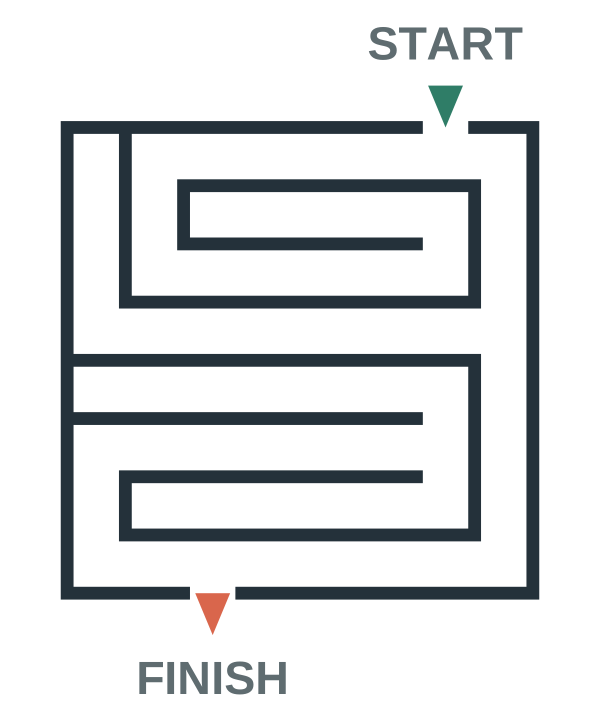
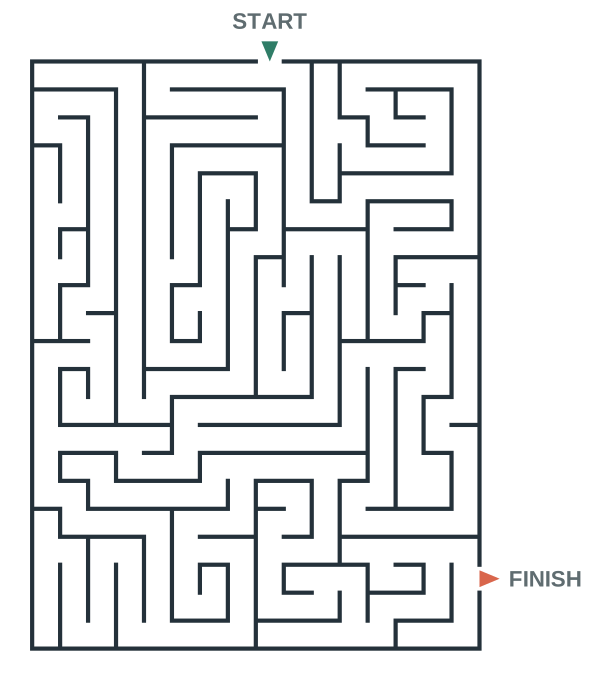
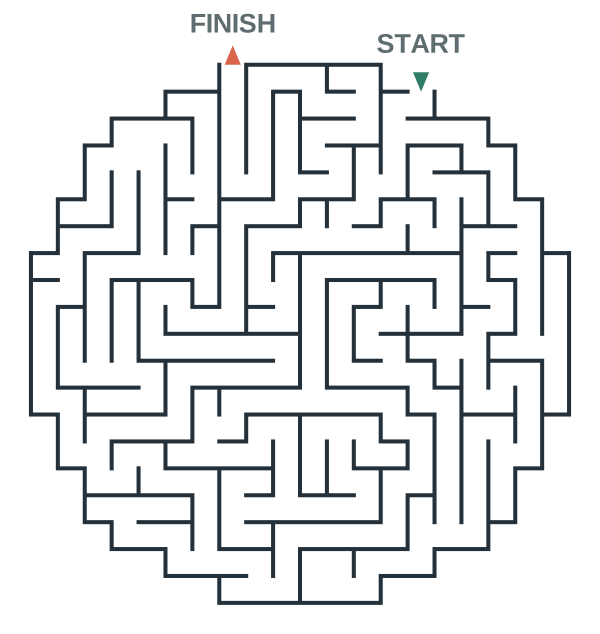
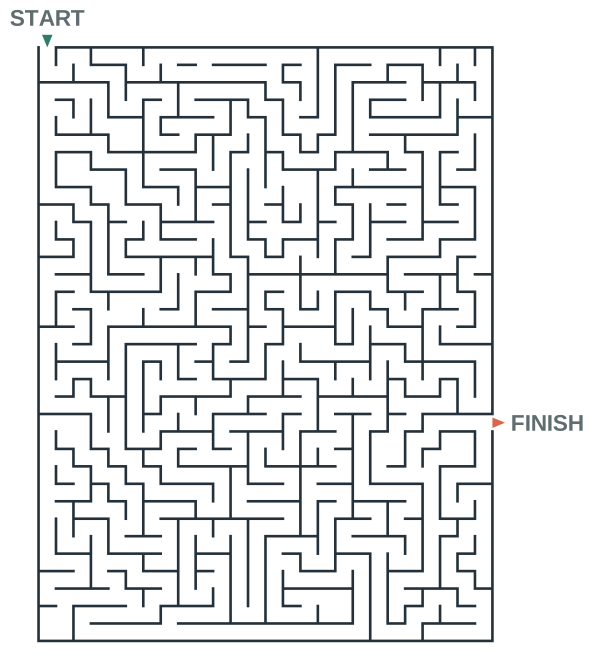
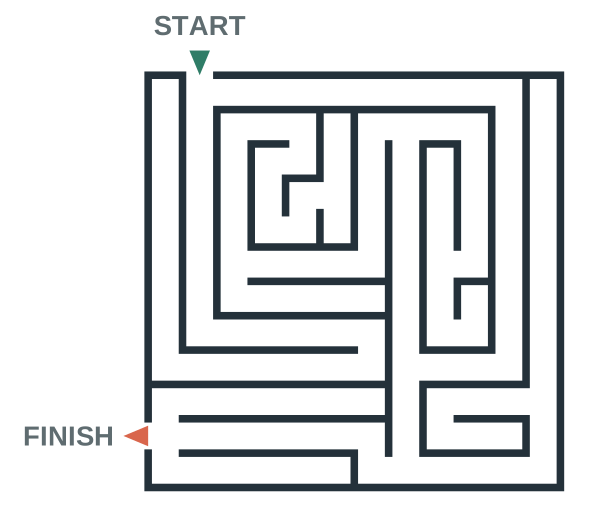
Maze guide
How to play and solve mazes
Drawing a line from the green arrow to the red one is the whole game. Below are two methods that get through any maze on this page, shown on a real maze from it, and which maze to print for whom.
How to play a maze
- Start at the green arrow, the way in.
- Draw one line through the open corridors to the red arrow, the way out.
- The line can turn as often as it likes, but it cannot cross a wall.
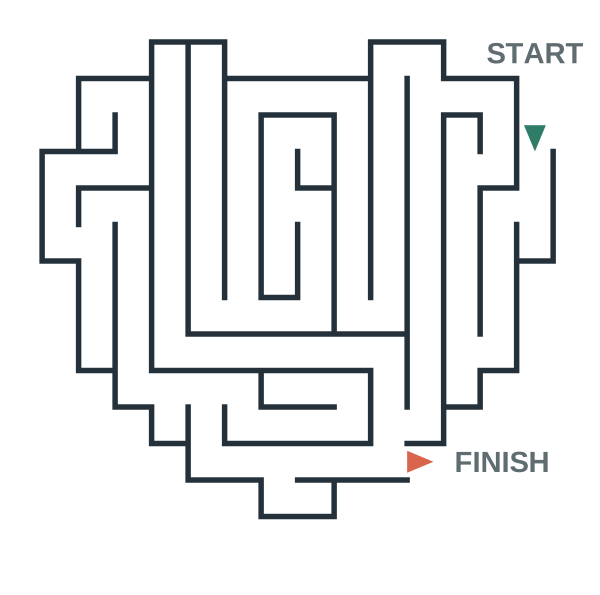
Every maze here has a way through, found and drawn on the solution page before the maze is printed. Here is an Easy heart maze from this page, and its solution.
How to solve a maze, step by step
The method that never guesses is dead-end filling. Shade every square with walls on three sides, then do it again, because shading one dead end often makes the square next to it a dead end too. Never shade the start or the finish. When nothing is left to shade, what is left white is the way through. Here it is on a 10×10 Easy maze from this page, computed rather than drawn by hand.
Round 1. Shade the 7 dead ends: squares with walls on three sides.
After round 4. 26 squares shaded. Each round makes new dead ends next to the old ones.
After round 10. 49 squares shaded. Each round makes new dead ends next to the old ones.
After round 27. 77 squares shaded, and the 23 left white are the route.
The quicker way on paper is the right-hand rule: put your pencil at the entrance and keep the wall on your right the whole way. Because the entrance and the exit are both on the outside wall, it reaches the exit on every maze this page makes, at every level, loops or not. It can fail on a maze whose finish sits in the middle, where the walls around the finish are not joined to the wall you started on; none of the mazes here are built that way. On this maze it walks 143 squares to find a route of 23, because it goes into every dead end on its side and back out again.
Three mistakes that cost the most time
- Shading the start or the finish. They have walls on three sides too, but the arrows are the openings.
- Switching hands halfway. The right-hand rule only works if the same hand stays on the wall the whole way.
- Expecting filling to finish a Hard maze. Loops have no dead ends, so filling stops at them and leaves the route plus some loops. Trace the white squares from the start, and if your line comes back to a square it has already crossed, back up to the last fork and take the other way.
Maze difficulty levels: what actually changes
On most maze sites a level is a label or a bigger grid. Here size and difficulty are separate settings: difficulty changes how often the corridors turn, how long the route between the arrows runs, and how many dead ends are opened into loops. These are averages from 24 mazes at each level on the same 16 × 21 rectangle of 336 squares, measured when this page is built.
| Level | Corridors | Route | Junctions on the route | Loops | Filling leaves only the route |
|---|---|---|---|---|---|
| Easy | Long and straight | 75 squares | 4 | 0 | 24 of 24 |
| Medium | Turn regularly | 113 squares | 10 | 1 | 6 of 24 |
| Hard | Twisty | 155 squares | 14 | 5 | 0 of 24 |
| Expert | Very twisty | 196 squares | 20 | 8 | 0 of 24 |
Junctions are squares on the route where three or more corridors meet, so a choice is made. The right-hand rule reached the exit on all 96 of these mazes.
Read the junction column to know how hard a maze feels: every junction is a decision. Loops change the method: on an Easy maze, dead-end filling always leaves just the route, while on Expert it leaves loops you have to choose between. Oddly, the right-hand rule gets more efficient as mazes get harder: it walks about 4.0 times the route on Easy but 1.6 times on Expert, because Easy's long straight dead ends are long walks in and out.
Where the arrows go changes too. On Easy and Medium the way in is near the top and the way out near the bottom. Hard and Expert put them at the two ends of about the longest route the maze holds, wherever that falls, so 19 of the 48 Hard and Expert mazes measured here have the finish within 9 squares of the start. Heading for the red arrow does not help on those.
Which maze to print
Size decides how long a maze takes; difficulty decides how much thinking it needs.
| Who it is for | Settings | Why |
|---|---|---|
| Preschool, ages 3 to 5 | Very small, Easy, large print, Start and Finish words off | Eight squares across a page makes each one big enough to draw in, bold walls make the edges easy to see, and the arrows work before a child reads. |
| Ages 5 to 7 | Small, Easy, one per page; try the heart or star | Long corridors let a child follow a line without lifting the pencil, and a shape makes it a picture. |
| Ages 7 to 10, classroom | Medium size, Medium, name and date on, two per page | Two to a page gives a fast finisher a second maze without another sheet of paper. |
| Ages 10 and up | Large, Hard, solution keys on | Long twisting routes with loops, and a key for when it stops being fun. |
| Adults | Extra large or Huge, Expert | Loops in the wrong-turn corridors mean dead-end filling alone will not finish it. |
| Seniors and low vision | Small or Medium size, Easy, large print, one per page | Fewer, wider corridors keep the sheet readable and finishable in one sitting. |
| Fine motor practice | Very small or Small, Easy, large print | The point is a steady line inside a channel, so the route should be short enough to finish in one go. |
Shaped mazes are cut out of a square grid, so they hold fewer squares than a rectangle at the same size: at the Large size a star uses 150 squares and a rectangle 520. Move a shaped maze up a size or two if a mixed pack should feel even.
| Shape | Grid at Large | Squares used | Smallest grid it needs |
|---|---|---|---|
| Rectangle | 20 × 26 | 520 | 6 wide |
| Square | 20 × 20 | 400 | 6 wide |
| Circle | 20 × 20 | 316 | 10 wide |
| Heart | 20 × 20 | 262 | 14 wide |
| Star | 20 × 20 | 150 | 14 wide |
| Diamond | 20 × 20 | 220 | 10 wide |
| Triangle | 20 × 20 | 220 | 10 wide |
- Solutions come with every PDF, after the mazes so they are easy to hold back, with no sign-up.
- Large print draws the walls half as thick again, so the edges stand out. It narrows the channel slightly, so pair it with a smaller size for a felt-tip pen or a wipe-clean marker on a laminated sheet.
- Ink saving draws the walls about two thirds as thick, in the same black rather than gray, so photocopies stay sharp.
- Every pack is new. New maze set draws a fresh batch with the same settings, so the answers to a class set are not on some other website.
- Turn the Start and Finish words off for pre-readers; the arrows carry the meaning on their own.
Free to print and copy
Every maze is made by this site's own generator, in your browser, and solved from entrance to exit before it prints; the route on the solution page is that solve. More on that in how we make puzzle packs. The terms of use let teachers, therapists, senior centers and families print and copy the mazes and solutions without asking.